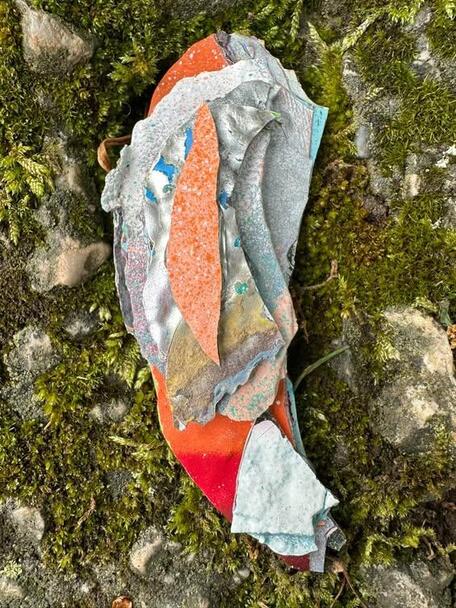
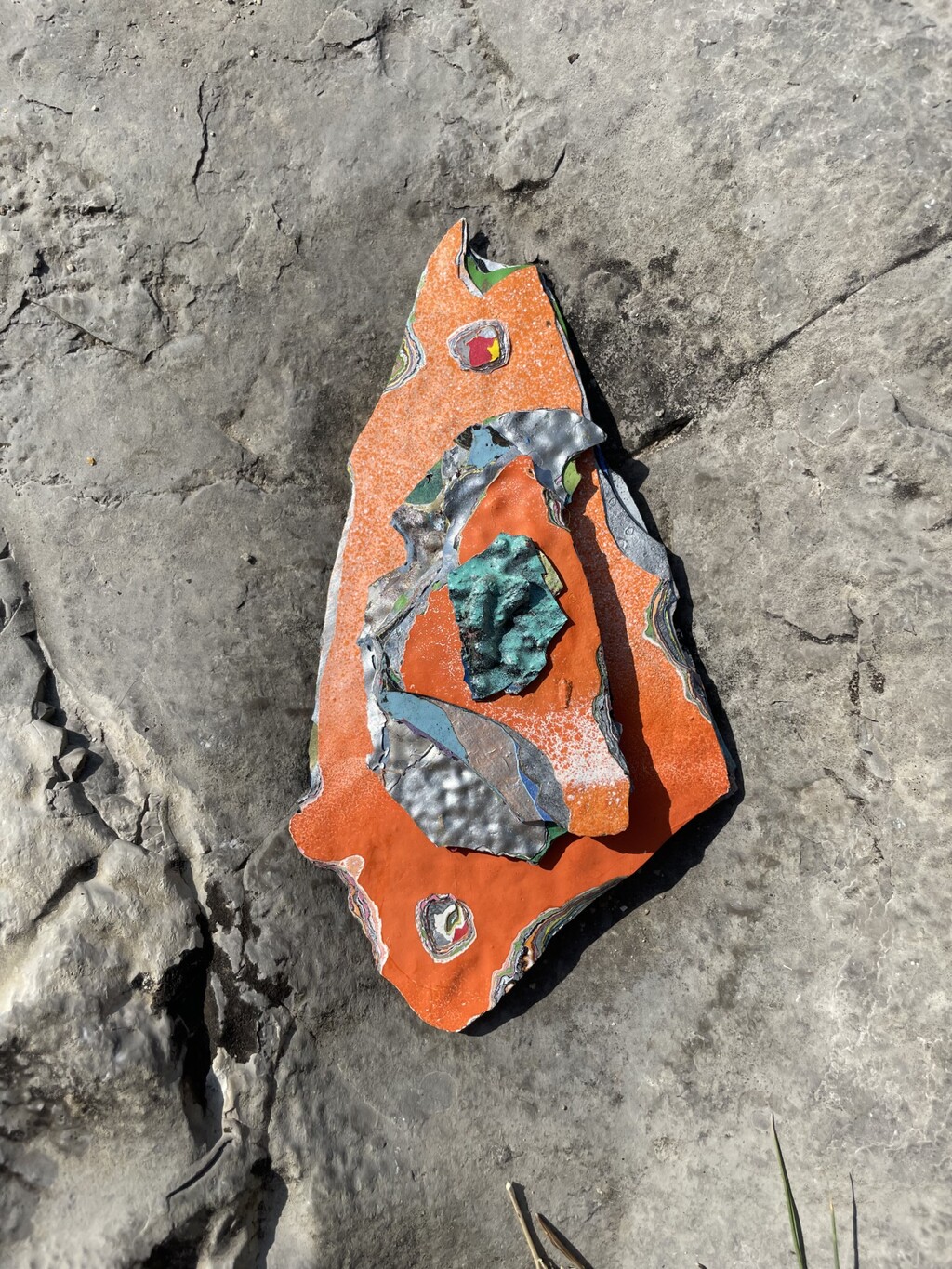
In his latest project, Brussels-based artist Eric Vanuytven turns back to the wall, literally. The work begins where urban memory accumulates: on city surfaces, in layers of graffiti, ad- vertisements, and anonymous marks. These strata, scraped and gathered like geological sam- ples, become the raw material of Sedimental Altars, a new series of sculptural installations that merge the urban and the natural, the human and the elemental.
Each fragment carries traces of time: pigments, scratches, the dust of cities. They are archives of lived experience, condensed into thin crusts of color and texture. Vanuytven treats them as a kind of collective hard drive, a compressed memory of coexistence, chaos, and expression. Once removed from their original walls, these layers are not preserved, they are offered. Placed within hand-carved altars mad of Ytong blocks,
the pieces are transported into na- ture: forests, fields, riverbanks. There, they meet the wind, the rain, the soil. These sculptures are not monuments. They are invitations, open to interpretation, to intention, to encounter. Visitors can find them, visit them, charge them, download from them. Each altar acts as a temporary interface between human networks and natural systems.
If Scar the Car was a ritual of grief, and Geoglyph an act of gratitude, then Sedimental Altarsis a work of reconciliation. It acknowledges what we leave behind, not as residue, but as ma- terial for renewal.
At once relic and ritual, sculpture and site, Sedimental Altars extends Vanuytven’s ongoingexploration of art as social and ecological sculpture. Each altar stands quietly in the land- scape, waiting, absorbing, transforming, marking a passage between worlds.